Monday, September 28, 2015

Hate Speech On YouTube: Freedom or Violation?


After I returned from Belgrade Pride, I decided to create a short video about this significant event. Shortly thereafter someone posted a comment calling me (supposedly) a very derogatory word in Serbian. That was my first comment! Not a 'bravo,' 'we support you,' or 'great job' - just hate speech. My first instinct was to delete the comment. Then I thought about responding instead. I decided on the latter. It got me thinking about whether speech like this is even permitted on Youtube. I certainly see it quite frequently on other comment feeds. The YouTube comments section seems to be a dumping ground for use-less, vitriolic, hate-filled speech. I often wonder why they let such behavior persist? Many say that it is allowed because it support a freedom of speech. I wonder if they would hold that opinion if that video was posted by their daughter or son. I wonder if they would defend their position if the hate speech was directed at a loved one. I wonder these things... So....

I recently did a poll to ask folks whether they thought 'hate speech' should be banned from the YouTube comments section. The results were rather shocking. In fact, the distribution of votes was pretty even across the board, with half the respondents saying 'yes' and the other saying 'no.' Does this surprise you?

Background
It is not very hard to find so-called hate speech on YouTube. Simply scroll down on any popular video and you might be shocked (or not) to see word garbage spewed onto large sections of the comment feed. Bigoted comments against women, people of different races, nationalities, sexual orientations, gender identities, body types, disabilities, religions, economic levels, or levels of education. Trash! So why is it there? Why does it remain if it is not positive? Why allow it in the first place? Why not ban such speech?

Just a taste of the lovely YouTube comments I see every single day. (these are the tame ones...)


'Hate Speech' Defined


1. (noun) Speech that attacks, threatens, or insults a person or group on the basis of national origin, ethnicity, color, religion, gender, gender identity, sexual orientation, or disability. (Random House)
 
In Law,  
Any speech, gesture or conduct, writing, or display which is forbidden because it may incite violence or prejudicial action against or by a protected individual or group, or because it disparages or intimidates a protected individual or group. The law may identify a a protected group by certain characteristics.

Hate speech is a communication that carries no meaning other than the expression of hatred for some group, especially in circumstances in which the communication is likely to provoke violence. It is an incitement to hatred primarily against a group of persons defined in terms of race, ethnicity, national origin, gender, religion, sexual orientation, and the like. Hate speech can be any form of expression regarded as offensive to racial, ethnic and religious groups and other discrete minorities or to women. (US Legal)

What About Facebook?
In 2013, the popular social network revised its policy regarding certain hate speech. The change didn't come from the kindness of their hearts but more rather the depth of their pocketbooks. Facebook is, after all, a business. No, the change came about from pressure from Women Action Media (WAM), The Everyday Sexism Project and writer and activist Soraya Chemaly. This was in regards to posted content endorsing domestic violence and rape. The campaign successfully urged major business to withdrawal their adverts from Facebook. (Huff Post) The result? Facebook acquiesced. But what about YouTube?

It's Distasteful, But Is It Legal?
YouTube discourages content that condones violence under 'Hateful Content':
"Our products are platforms for free expression. But we don't support content that promotes or condones violence against individuals or groups based on race or ethnic origin, religion, disability, gender, age, nationality, veteran status, or sexual orientation/gender identity, or whose primary purpose is inciting hatred on the basis of these core characteristics. This can be a delicate balancing act, but if the primary purpose is to attack a protected group, the content crosses the line." Community Guidelines
In fact, YouTube has specifically stated that 'Hate speech is not permitted.' (YouTube Policy Center)!
 So there it is. What does this mean, exactly?
"Hate speech refers to content that promotes violence or hatred against individuals or groups based on certain attributes..."
They encourage users to flag content, or file a report for repeated violations. Has anyone done this? What does this actually mean?

My Reflection
After all this poking around, I learned a lot from the side of the "free speech"ers. I began to see hate speech as an opportunity to start a dialogue. If only all hate-mongers actually wanted to engage in civil discourse... Sigh. Next time I see such speech, I'll be the first to open up that dialogue and see what happens. I'll even post it to my next blog. Such BS needs to be put on BLAST!


Friday, September 25, 2015

Belgrade Hosts LGBT Pride Parade, Less Police Indicates Progress

Participants were all smiles at the 2015 Belgrade LGBT Pride Parade
Re-posted from Historia-Ime.com

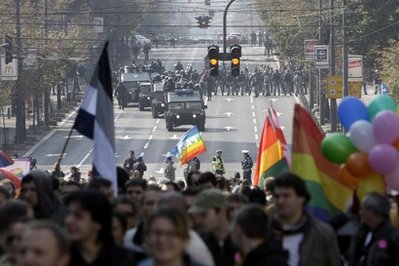
Belgrade, Serbia - More than 1,200 individuals gathered in Belgrade last Sunday (Sept. 21st) to march in a pride parade to support the LGBT (Lesbian, Gay, Bisexual, and Transgender) community in Serbia. This is the second year in a row that such a pride parade has happened in this central Balkan country without any incidence of violence. In 2010, parade-goers were met with hostility and violence from extremists, injuring at least 95 participants and police (according to the BBC). Last year, marchers were surrounded by thousands of Serbian riot police in an effort to ensure the safety of participants and the success of the event overall. This year saw a drastic decrease of 50% in police presence needed at the event (according to Civil Rights Defenders)

Serbia, a former Yugoslav state, is now an EU Candidate (according to BBC) and is negotiating its EU accession (according to World Bank). The parade has been seen as a test for the Serbian government to prove its commitment to EU standards on Human Rights (according to NBC News). In a show of support, marchers were joined by Serbia's European Integration Minister Jadranko Joksimovic, Culture and Information Minister Ivan Tasovac, and Belgrade Mayor Sinisa Mali. (according to RFERL). 

Bekim Asani, president of LGBT United Tetovo Macedonia has been a participant in the parade before and noted progress:

“I saw less people than last year but found a more supportive environment… Last year I was more scared. This year I was freer. It was real pride with a lot of music, dancing, and rainbow flags. For first time I saw people supporting the pride from their balconies and windows.”

Similar pride parades have occurred in the Balkan region, with varying degrees of acceptance from locals. Some communities have yet to host a pride event, such as in Niksic, Montenegro, where the government has banned such an event for the third time this year. Asani comments on the possibility of a pride event in his community “Macedonia is in deep political crisis... I can't say much about organizing pride. Who knows? Maybe soon…”

The Serbian Orthodox Church had condemned the parade in the past and had again staged a quiet, yet smaller protest this year, yet less violence and a smaller protest could indicate more acceptance among Serbians for LGBT people. Civil Rights Activist Ivan Mitic, 21, of Serbia, sees progress here, noting:
  
“It (the 2015 Belgrade Pride Parade) showed that we made a move forward - maybe a little one, but still, we made it. If you read comments on forums, there is so much hate speech, but that is something that is hard to change. Journalists had more positive reporting than in previous years. Despite all those negative comments… there were many comments showing support to pride and explaining (…) why is it important.”  

-          Written by Jon Breen, LGBT Rights Activist

Thursday, September 24, 2015

Tuesday, September 22, 2015

Don't Put Jack In The Box (He Won't Stay!)


^^^^^^^^^^^^^^^^^^^^^^^^^^^~CHECK OUT MY VIDEO ABOVE~ ^^^^^^^^^^^^^^^^^^^^^^^^

The sign is in Serbian means 'My rights, my demands' (rough translation)
What an amazing last several days this has been! I have been back in Librazhd for a day now, and so far nobody in my community has mentioned anything about my participation in the pride event. The pitchforks never made an appearance thankfully! It is a bit strange really, after an experience like this. I come back to Librazhd with nothing but a group of young guys (cunes) hollering at me in the street, and making meaningless conversation. They were most likely drunk and just being silly, but I just thought it so weird. They asked what I was up to. I said I just came back from Serbia. They were shocked, and a few seconds later, asked if I met a nice Serbian girl. Sigh.........  And these are people who can see all my Facebook posts! I'm laughing and crying at the same time. Mostly, I'm just glad to be back. The truth is I missed Librazhd. I really did.

A proud moment holding the Pride flag down the streets of Belgrade. That's me in the blue shirt (in case you didn't know)

Well-protected, at any cost.
I think sometimes that I should be less ostentatious about my gay-ness - that I should tone it down a bit. To go from diva to queen, or queen to fairy, or something like that. I don't know the order. Anyway. When I was walking up to the parade, I just felt a sudden rush of adrenaline that really made me want to be... well... me! I wanted to be me for a long time now. Being in Peace Corps kinda puts one in an awkward situation of potentially going back in the closet. That's what happened to me. Well, I decided to go in the closet because it was suggested and took that suggestion. But now? Well, now I'm a big 'ol gay jack-in-the-box., and I can't seem to but the lid back on... Pop! There I go again, bustin' out the door! No closet for me. No sir-ee.

Me and my friend Bunny

Many of you reading might be thinking "oh hell, here we go... I hope he knows what he's doing." Actually, that's what I think to myself too! The truth is, no one has ever been in this particular situation before. Not now. Not in Albania. Not in my community. Not me. So....

Is it a wise decision to continue down this path? I believe so.
Do I know it will be completely safe? Absolutely not.
How do I feel about it? Scared, but certain. This is the right thing to do.

I'd always prefer to be me, even if it means walking blindly into the night. This past week has strengthened my resolve, and further solidified my conviction.

From left to right - Peter Tatchell (Peter Tatchell Foundation), Tanya Domi (Columbia University), Brian Silva (Marriage Equality USA), Irene Hemelaar (LGBTI Emancipation),  and Frank Van Dalen (Politieke Academie, Amsterdam)


During the week leading up to the Pride Parade, they held the Belgrade Pride Conference presented by Civil Rights Defenders. I found the lectures and panels quite interesting. Discussions included LGBT activists speaking on the realities of their respective communities, local journalists articulating the struggles of the media in Serbia, NGOs speaking about grassroots efforts, and elected officials and representatives putting the LGBT discussion in terms of European Integration and refugees. The buzzword of the week was "Cross-sectionality" seeing our struggles not as one singular effort, but as an interaction of many intersecting populations and needs, taking every perspective into account. The panels gave everyone in the room a chance to hear many different perspectives and to learn about the unique situation of each LGBT person in that room. Hopefully we all came out of that room appreciating just how unique we all are.

A panel of LGBT Activists (from left to right) - Mona (Kosovo), Lejla (Bosnia), Xheni (Albania) and Danijel (Montenegro);
Moderator Vasilika (Albania)

During the course of the week, I got the chance to meet queer activists from all over the Balkans - Macedonia, Kosovo, Montenegro, Serbia, Greece, Albania, and Bosnia/Herzegovina. Although I don't know any Greek, and only a few phrases in Serbian, most people spoke enough English to converse. I could speak with the Albanians and Kosovars as they both speak Albanian. Lucky for me, at a conference like this, pretty much all the debates, lectures and panels are held in English. We did have headsets for the sessions where multiple languages were spoken. At times I found it hard to really understand the translations coming through the headsets, but it was certainly better than nothing. I feel so grateful to hear their opinions and viewpoints. Having a voice is what this is all about. The freedom to express ourselves. The freedom to get together, assemble, and make ourselves known to the world. :-)

We may live in different countries, but we are activists. We are family. 


Monday, September 21, 2015

Belgrade Pride: On My Way Home...

Gay Pride 2015
Belgrade Pride 2015

Belgrade Pride is over and I am on my way back to my site in Albania with a short stop in the capital. I can't help but wonder how my local community will react to my participation in this event. I have been posting a lot of photos, videos and news articles on Facebook lately about Belgrade Pride. I have also been quoted by the AP and AFP, so my name is starting to float all around the web for this event. There are also countless photos and videos of pretty much everyone there captured by hundreds of journalists in attendance. This was indeed a mass media event! I am hoping that I don't come home to villagers with pitchforks ready to drive the gay American out. It may be laughable, but it is a concern. The danger may not always be around, but it is REAL. Gossip spreads really fast here, and one step over the line can cost a volunteer his site.

I'm hoping all this coverage will reach the Serbian general population (in an appropriate way.) One never knows the angle a reporter will take. Depending on the hot topic du jour, one could place this event in a positive way or in a potentially harmful way. That is the power of the media - the former angle fostering harmony, the latter creating division.

Thursday, September 17, 2015

Hot Topic - Gearin' up for Belgrade Pride!

Belgrade Pride 2010 - Photo credit: http://kaosgl.org/page.php?id=9540

I will attending a conference in Belgrade, Serbia this week at the invitation of an organization in Albania called Civil Rights Defenders. The focus will be Belgrade LGBT Pride. Wow. Let that sink in for a moment.

If Serbia is not the first place you associate with LGBT Pride, you are not alone. Many Americans only recall Serbia from its role in bloody rivalries and wars for independence during post-Yugoslavia days of the early 1990's. Words like Croats, Serbs, and Bosnians were thrown around like hot coals from journos setting the fears of many an American ablaze. This is not the place where one throws a Pride. Or is it?

The struggle for LGBT rights in this land-locked Eastern European country has not been easy. Back in 2010, the parade was seen with an anti-gay riot . Some 5,000 police held back the anti-gay rioters from event participants.

Belgrade Pride 2010: Photo from: http://kaosgl.org/

Truth be told, after I read this, I was initially somewhat nervous about going. But never once did I think twice about wanting to go. This is what I need to do. I need to help people here. I need to be there because other people can't. I need to show up and do my part because other LGBT individuals will die if I don't. I need to march, because somebody marched for me in 1970 in San Francisco. I wouldn't have the life I have today if they didn't. We'd still be living the Anita Bryant era of horror and BS.

I was able to attend the first LGBT March in Albanian history last year (although there has been an annual LGBT bike ride each year that started around 5 years ago). This year I will be able to attend another groundbreaking march. Although it may not be the first pride parade there, it is so very important. I thought of Albania's bloody feuds with the so-called neighbors to the north. After the conflict between Albania and Serbia over Kosovo's independence from Serbia, the two countries still seem to keep their distance. (Including the infamous Albania-Serbia futbol match). Political relations between the two seem amicable, yet with a seeming undercurrent of resentment over Kosovo.


Tirana Gay Ride 2014!
All politics aside, I will be there on a completely different capacity. I will be there to support Belgrade Pride and the Balkan LGBT Community. Previous years saw conflict, violence and civil unrest. As with any civil rights movement, things are getting better. Just how much better it is now? Well, I suppose we will find out. With many of the Balkan's best LGBT activists gathered together, the stage is set for quite a spectacle. And what a spectacle it will be.